
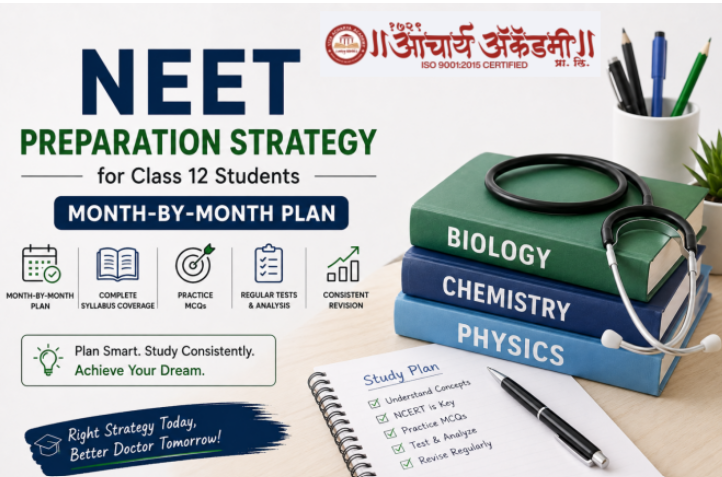
Class 12 is one of the most important academic years for students preparing for the National Eligibility cum Entrance Test (NEET). Managing board examinations alongside competitive exam preparation requires consistency, planning and the right guidance. A well-structured NEET preparation strategy for Class 12 students can help aspirants complete the syllabus on time, strengthen concepts, revise effectively and gradually improve their test performance.
NEET-UG is conducted by the National Testing Agency (NTA) as the common entrance examination for undergraduate medical education in India. The official NTA website publishes the latest syllabus, information bulletins, notices and examination updates, making it essential for students to follow official information while planning their preparation.
For Class 12 students, the challenge is not simply studying for more hours. The real challenge is studying consistently, prioritising important concepts, practising questions and regularly analysing mistakes.
This month-by-month guide provides a practical roadmap that students can adapt according to their school schedule, coaching timetable and individual strengths.
Why Class 12 is Crucial for NEET Preparation
Class 12 brings a substantial academic workload. Students have to prepare for school examinations and board examinations while simultaneously working towards NEET.
A strong NEET preparation strategy for Class 12 students should therefore integrate board preparation with NEET preparation instead of treating them as two completely separate goals.
The three major priorities should be:
- Build strong conceptual understanding.
- Complete the NEET syllabus systematically.
- Revise and test yourself repeatedly.
Students should avoid waiting until the end of Class 12 to start serious NEET preparation. Every month should have a defined objective.
Month-by-Month NEET Preparation Strategy for Class 12 Students
| Month | Primary Focus | Key Target |
| Month 1 | Foundation | Understand syllabus and build study routine |
| Month 2 | Concept Building | Strengthen Physics, Chemistry and Biology |
| Month 3 | Practice | Start intensive MCQ practice |
| Month 4 | Syllabus Progress | Complete chapters systematically |
| Month 5 | Revision | Revise completed chapters |
| Month 6 | Testing | Increase chapter and unit tests |
| Month 7 | Board + NEET Balance | Integrate board and NEET preparation |
| Month 8 | Full Syllabus Progress | Complete remaining important topics |
| Month 9 | First Major Revision | Revise Class 11 + Class 12 |
| Month 10 | Mock Tests | Begin regular full-length tests |
| Month 11 | Intensive Revision | Focus on weak areas and accuracy |
| Month 12 | Final Preparation | Mock tests, revision and exam strategy |
Month 1: Understand the Syllabus and Build Your Routine
The first month should focus on creating a realistic foundation.
Begin by understanding the latest official NEET syllabus rather than relying on outdated chapter lists. The NTA website provides the official NEET syllabus and examination documents.
Create a subject-wise plan for:
- Physics
- Chemistry
- Biology
At this stage, students should identify chapters that they find difficult and chapters where their concepts are already strong.
What to do this month
- Create a daily study timetable.
- Allocate separate time for all three subjects.
- Start maintaining an error notebook.
- Read Biology from NCERT carefully.
- Understand concepts before solving MCQs.
- Set weekly academic targets.
The objective is not to complete maximum chapters immediately. The objective is to develop consistency.
Month 2: Strengthen Your Concepts
Once the routine becomes stable, focus on conceptual learning.
Physics
Physics requires understanding followed by problem-solving. After studying a concept, solve basic questions before moving to NEET-level MCQs.
Chemistry
Divide Chemistry into:
- Physical Chemistry
- Organic Chemistry
- Inorganic Chemistry
Maintain separate revision notes for formulas, reactions and important concepts.
Biology
Biology requires detailed and repeated reading. NCERT should remain a central part of your Biology preparation.
Students should highlight important lines, diagrams and terminology and revise them regularly.
Month 3: Start Intensive MCQ Practice
By the third month, students should increase their question-solving practice.
A common mistake is spending too much time reading theory without testing whether the concepts can actually be applied.
Start with chapter-wise MCQs.
Recommended approach
Learn → Revise → Solve → Analyse → Repeat
Do not simply count the number of questions solved. Analyse every incorrect question.
Ask:
- Did I misunderstand the concept?
- Did I forget a formula?
- Did I misread the question?
- Was the mistake due to calculation?
- Did I choose the answer too quickly?
This analysis is an important part of an effective NEET preparation strategy for Class 12 students.
Month 4: Accelerate Syllabus Completion
The fourth month should focus on maintaining momentum.
Students should aim to complete planned chapters without compromising understanding.
Create weekly targets rather than unrealistic daily targets.
For example:
| Subject | Weekly Goal |
| Physics | 1–2 chapters/concepts + MCQs |
| Chemistry | 1–2 chapters + revision |
| Biology | 2–3 chapters + NCERT revision |
The exact target should depend on chapter difficulty and your coaching or school schedule.
Month 5: Begin Structured Revision
At this stage, previously completed chapters should not be forgotten.
Revision should become a regular part of your timetable.
Use a three-level revision system:
Revision 1
Revise the chapter shortly after completing it.
Revision 2
Revise it after a few weeks.
Revision 3
Include it in cumulative tests and full-syllabus revision.
This spaced approach helps students retain information for longer periods.
Month 6: Increase Testing and Performance Analysis
Testing is not only for measuring marks. It is a preparation tool.
Start taking regular chapter tests and unit tests.
After every test, maintain a simple performance record:
| Parameter | Track |
| Total Questions | Number attempted |
| Correct Answers | Accuracy |
| Incorrect Answers | Mistakes |
| Unattempted | Time/knowledge issues |
| Weak Chapters | Topics requiring revision |
| Time Taken | Speed |
Do not become discouraged by low marks in early tests. Instead, use them to identify areas for improvement.
Month 7: Balance Board Exams and NEET
Class 12 students often struggle because they treat board preparation and NEET preparation as completely separate.
Many Class 12 concepts overlap with NEET preparation. Therefore, students should use board studies to strengthen their conceptual foundation.
For example:
- Learn Physics concepts thoroughly for boards and then practise NEET MCQs.
- Study Chemistry theory for boards and solve application-based NEET questions.
- Study Biology chapters from NCERT for both board preparation and NEET.
The key is to avoid duplication of effort.
During school examination periods, adjust your NEET timetable instead of abandoning preparation completely.
Month 8: Complete Remaining Topics
By this stage, students should be moving towards syllabus completion.
Identify three categories:
Green: Strong chapters
Yellow: Average chapters
Red: Weak chapters
Spend more revision time on the red and yellow categories while maintaining your strong areas through regular tests.
A strong NEET preparation strategy for Class 12 students should be flexible enough to accommodate individual weaknesses.
Month 9: First Major Revision
Now begin your first serious cumulative revision.
Revise Class 12 thoroughly and start integrating important Class 11 topics.
Biology
Focus on:
- NCERT reading
- Diagrams
- Tables
- Terminology
- Previous questions
- Chapter-wise MCQs
Chemistry
Revise:
- Reactions
- Formulas
- Concepts
- Periodic trends
- Important exceptions
- Numerical problems
Physics
Revise:
- Formulae
- Concepts
- Important applications
- Numerical problems
- Frequently repeated question types
Month 10: Start Full-Length Mock Tests
Students should gradually transition from chapter tests to full-length NEET-style tests.
The purpose of a mock test is to replicate the pressure of an actual examination.
After every mock test, spend sufficient time analysing it.
Follow the 3-step test analysis method
Step 1: Identify mistakes
Find every incorrect and doubtful question.
Step 2: Find the reason
Determine whether the problem was conceptual, factual, calculation-based or due to time pressure.
Step 3: Correct the weakness
Revise the relevant topic and solve similar questions.
Remember: A test without analysis is an incomplete test.
Month 11: Intensive Revision and Accuracy Building
At this stage, students should avoid constantly changing study materials.
Use limited, reliable resources and revise them repeatedly.
Focus on:
- NCERT Biology
- Important Chemistry concepts and reactions
- Physics formulas and problem-solving
- Previous-year questions
- Mock tests
- Error notebook
Accuracy becomes increasingly important as students approach the examination.
Do not attempt questions simply because you want to increase your attempt count. Develop the ability to identify questions you can solve confidently.
Month 12: Final Revision and Exam Readiness
The final month should be about revision, testing and confidence, not learning everything from scratch.
Create short revision cycles.
Daily priorities
- Biology NCERT revision
- Chemistry revision
- Physics formula revision
- MCQ practice
- Mock-test analysis
- Weak-topic revision
Avoid unnecessary stress and major changes to your preparation strategy.
Maintain proper sleep, nutrition and breaks. A tired mind cannot perform at its best.
Subject-Wise NEET Preparation Strategy
Biology
Biology carries significant importance in NEET preparation. Students should focus heavily on NCERT-based learning.
Strategy:
- Read the chapter carefully.
- Mark important facts.
- Revise diagrams.
- Solve MCQs.
- Review incorrect answers.
- Re-read difficult portions.
Repeated revision is more valuable than reading the same chapter once for several hours.
Physics
Physics requires regular problem-solving.
Follow:
Concept → Formula → Example → MCQs → Test
Do not postpone numerical practice. Even if a chapter appears difficult initially, solving progressively easier-to-harder questions can improve confidence.
Chemistry
Chemistry requires different approaches for different sections.
Physical Chemistry
Practise numerical problems regularly.
Organic Chemistry
Understand reaction mechanisms and revise reactions systematically.
Inorganic Chemistry
Pay close attention to NCERT content, trends and important facts.
How Many Hours Should a Class 12 Student Study for NEET?
There is no universal number of hours that guarantees success.
The quality and consistency of study matter more than simply sitting with books for long hours.
A student may start with focused study sessions and gradually increase them according to school, coaching and personal requirements.
A practical structure could be:
| Activity | Suggested Focus |
| School/Classes | Attend attentively |
| Daily Revision | 1–2 focused sessions |
| MCQ Practice | Daily |
| Biology NCERT | Daily/regularly |
| Test | Weekly initially |
| Test Analysis | After every test |
Students should customise this according to their individual schedule.
Common Mistakes Class 12 Students Should Avoid
1. Waiting for Class 12 syllabus to finish
NEET preparation should not be postponed until boards are over.
2. Collecting too many books
More resources do not automatically mean better preparation.
3. Ignoring Biology NCERT
Repeated NCERT revision should be an essential component of preparation.
4. Avoiding mock tests
Tests reveal weaknesses that ordinary studying may not expose.
5. Not analysing mistakes
Marks improve when students understand why they lost marks.
6. Comparing daily progress with others
Every student has a different academic starting point. Focus on measurable personal improvement.
Why Choose Acharya Academy for NEET Preparation?
A structured coaching environment can help students maintain consistency, clarify doubts and regularly evaluate their progress.
Acharya Academy provides preparation support for students targeting competitive examinations including NEET. Its branches include Baramati, Wakad, Rahatani and Chh. Sambhajinagar, providing students with access to a local learning environment and structured academic guidance.
Students and parents can explore Acharya Academy’s programs and get in touch through the official Acharya Academy Contact Us page.
The academy’s emphasis on expert guidance, competitive learning and performance-oriented preparation can help students build the discipline required for a demanding examination such as NEET.
NEET Preparation Strategy: A Simple Formula for Success
A successful preparation journey can be summarised as:
Concepts + NCERT + MCQs + Revision + Tests + Analysis + Consistency = Better NEET Preparation
Do not expect dramatic improvement overnight.
If your score is 450 today, work towards 500. Then 550. Then 600 and beyond.
Every test should provide a lesson. Every mistake should become a learning opportunity.
Frequently Asked Questions (FAQs)
1. When should Class 12 students start NEET preparation?
Ideally, NEET preparation should begin alongside Class 12 studies rather than waiting until the board examinations are completed. Starting early allows students to distribute the workload across the academic year.
2. Is NCERT enough for NEET Biology?
NCERT should be a core resource for Biology preparation. Students should read it carefully and supplement it with appropriate question practice and revision.
3. How can I prepare for boards and NEET together?
Integrate both preparations wherever the syllabus overlaps. Study the concept thoroughly for boards and then practise NEET-oriented MCQs based on the same topic.
4. How often should NEET mock tests be taken?
Initially, students can use chapter and unit tests. As the syllabus progresses, gradually increase the frequency of cumulative and full-length tests.
5. What should I do if my NEET mock-test marks are low?
Do not panic. Analyse the test and categorise mistakes into conceptual, factual, calculation and time-management errors. Then revise those areas and retest yourself.
6. Is coaching necessary for NEET?
Students can prepare independently, but structured coaching can provide academic planning, regular tests, doubt-solving and performance tracking. The right choice depends on the student’s learning style and requirements.
7. Can Class 12 students improve their NEET score significantly?
Yes. Consistent preparation, regular revision, question practice and systematic test analysis can lead to substantial improvement over time.
Conclusion
A successful NEET journey is built through disciplined preparation rather than last-minute effort. For Class 12 students, the right NEET preparation strategy should balance school academics, board examinations and competitive exam preparation throughout the year.
The most important principle is simple: do not wait for the perfect time to start. Start with the time you have and improve your preparation every day.
Follow a month-by-month plan, revise consistently, solve MCQs, analyse your mistakes and regularly measure your progress. With the right strategy, focused effort and expert guidance, Class 12 can become the year that transforms your medical entrance preparation.
Acharya Academy supports NEET aspirants through its branches in Baramati, Wakad, Rahatani and Chh. Sambhajinagar. Students can also explore the academy’s achievements and student outcomes on the official Acharya Academy Results page.
Ready to Start Your NEET Preparation?
Do not wait until the syllabus piles up or board examinations are over. Start planning your preparation today.
Register for free counselling with Acharya Academy and get guidance on the right NEET preparation strategy, study plan and academic roadmap for your goals.

Your medical dream deserves a strategy. Start today. Prepare consistently. Aim higher. Achieve your goal with Acharya Academy.