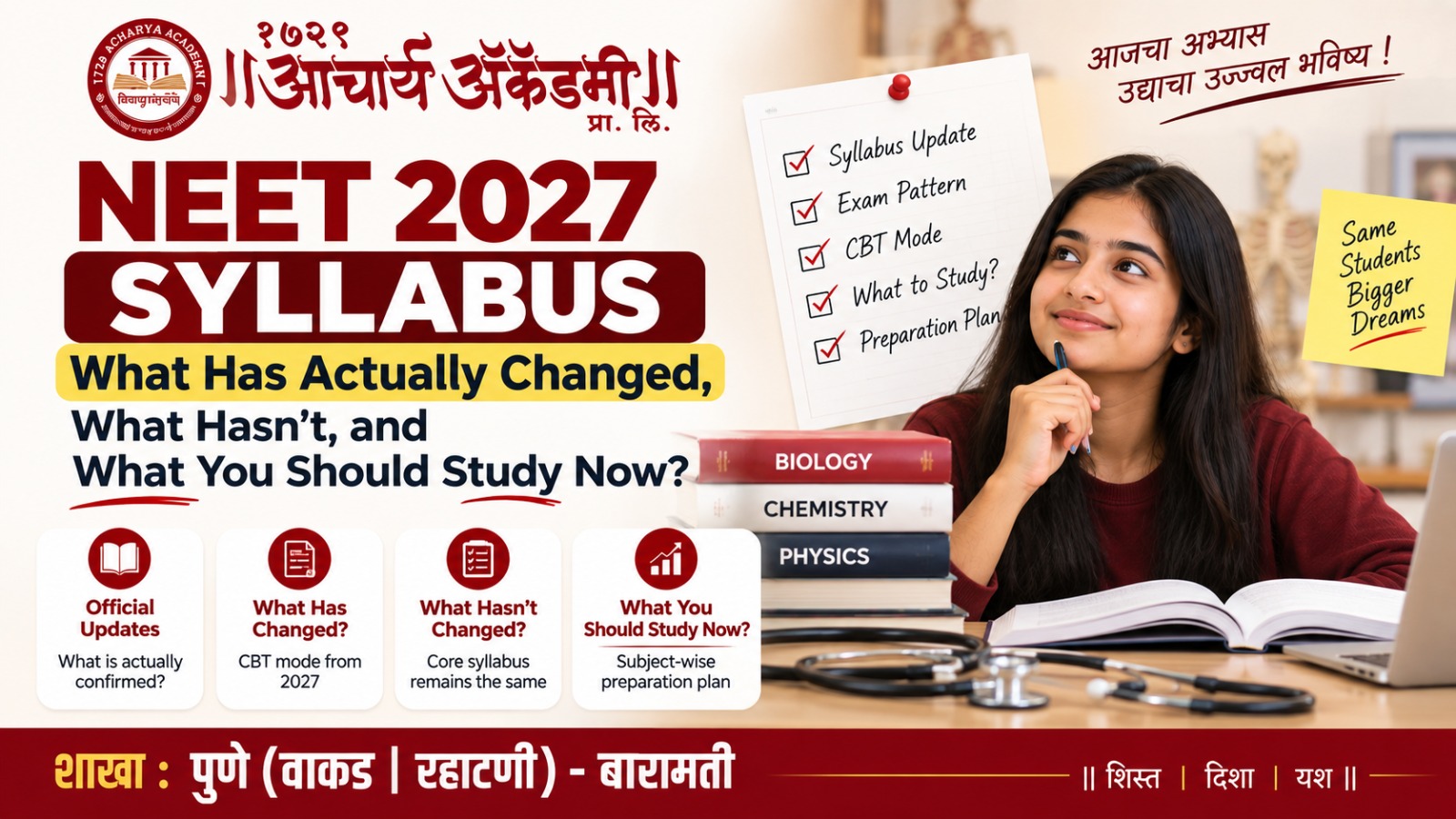
If you are preparing for NEET 2027, you have probably encountered countless posts claiming that the syllabus has changed, chapters have been eliminated, or that your entire study strategy needs a reboot.
Before overhauling your preparation schedule, pause and separate official policy from online speculation.
The National Medical Commission (NMC) and the National Testing Agency (NTA) finalized and confirmed the syllabus framework for recent cycles, providing a clear academic baseline. As of now, students should not treat unverified lists circulating on social media as the final NEET 2027 syllabus.
The best strategy for a NEET 2027 aspirant is simple: do not wait. Build your foundation around the established Physics, Chemistry, and Biology syllabus, master your NCERT textbooks, practice questions consistently, and remain agile enough to incorporate official notices when published.
NEET 2027 Syllabus: What Is Actually Confirmed?
There is a fundamental difference between the latest officially published syllabus and speculative syllabus updates for a future exam.
- The National Medical Commission (NMC) issues the official NEET UG syllabus, which the National Testing Agency (NTA) adopts for the examination.
- For NEET 2027 aspirants, the latest officially established syllabus serves as the primary academic blueprint.
- Do not treat coaching predictions, YouTube clickbait, WhatsApp forwards, or unofficial forums as authorized notifications.
What Has Actually Changed for NEET 2027?
The most critical confirmed development for NEET 2027 pertains to the examination mode, not the academic subject matter.
- Computer-Based Test (CBT) Mode: NEET UG is transitioning to a computer-based format.
- Format vs. Content: A change in testing mode impacts screen reading, digital time management, and online navigation. It does not automatically indicate that chapters in Physics, Chemistry, or Biology have been altered.
What Hasn’t Changed?
The core academic framework remains identical:
$$\text{Physics} + \text{Chemistry} + \text{Biology}$$
- Conceptual Rigour: You still require in-depth understanding, extensive numerical practice, and systematic revision.
- NCERT Centrality: NCERT textbooks remain the cornerstone of preparation, especially for Biology and Inorganic Chemistry.
- The Core Study Loop:$$\text{Learn} \longrightarrow \text{Practise} \longrightarrow \text{Revise} \longrightarrow \text{Test} \longrightarrow \text{Analyse}$$
Should You Wait for the NEET 2027 Syllabus?
No. Putting your studies on hold while waiting for an official document wastes valuable months.
NEET covers extensive ground across three distinct disciplines:
- Physics requires deep conceptual clarity, formula derivation knowledge, and mathematical problem-solving.
- Chemistry demands a balance of numerical fluency, mechanism mastery, and factual retention.
- Biology requires line-by-line reading, rapid recall, and systematic revision cycles.
These cognitive skills require consistent training over time.
What Should NEET 2027 Students Study Now?
Continue working systematically through the established NEET syllabus. Start by setting up a centralized Chapter Tracker to monitor your metrics:
| Subject | Chapter Name | Concept Cleared | MCQ Practice (Min. 100) | NCERT Revision | Error Log Updated |
| Physics | Kinematics | [ ] | [ ] | [ ] | [ ] |
| Chemistry | Chemical Bonding | [ ] | [ ] | [ ] | [ ] |
| Biology | Cell: The Unit of Life | [ ] | [ ] | [ ] | [ ] |
Subject-Wise Preparation Strategy
1. Physics: Concept First, Speed Second
Follow a structured execution loop for every chapter:
$$\text{Concept} \longrightarrow \text{Solved Examples} \longrightarrow \text{Topic MCQs} \longrightarrow \text{Timed Practice} \longrightarrow \text{Error Analysis}$$
Avoid blind formula memorization. Always identify:
- Physical significance of the equation
- Exact boundary conditions and assumptions
- Units, dimensions, and standard variable relationships
Maintain a dedicated Physics Error Log categorized by error type:
- Conceptual lapse
- Calculation or sign error
- Incorrect formula application
- Misread question stem
- Time pressure error
2. Chemistry: Area-Specific Execution
- Physical Chemistry: Treat like Physics. Focus on fundamental laws, formula mastery, unit conversions, and regular numerical drills.
- Organic Chemistry: Emphasize reaction mechanisms, inductive/resonance effects, functional group conversions, and named reactions.
- Inorganic Chemistry: Stick closely to NCERT line-by-line reading, periodic trends, exceptions, and structured flashcard revision.
3. Biology: High-Retention Revision
- Complete detailed line-by-line NCERT readings.
- Annotate diagrams, labels, summary sections, and introductory unit notes.
- Solve topic-wise MCQs and previous years’ questions (PYQs).
- Schedule cumulative active recall sessions rather than single, passive re-readings.
Handling Rumours: Deletions and Additions
- If a chapter is rumoured to be deleted: Keep it in your study cycle until NMC releases an official notification. Verifying updates directly via official portals protects your preparation schedule.
- If topics are added later: Map the revised syllabus against your Chapter Tracker. Tag topics into three operational groups:
- Already Mastered
- Needs Targeted Revision
- New / Unstudied Additions
A syllabus revision is an organizational adjustment, not an emergency.
Syllabus vs. Exam Pattern: Avoid the Confusion
- Syllabus: Defines what academic content you are expected to master.
- Exam Pattern / Mode: Defines how that knowledge is assessed.
The shift toward a Computer-Based Test (CBT) requires developing digital examination stamina alongside academic revision.
Preparing for NEET CBT Mode
- Train your focus on reading long stems and case studies directly from screens.
- Practice navigating digital question palettes (Answered, Unanswered, Marked for Review).
- Conduct timed sectional drills on a desktop or laptop.
- Use scratch paper efficiently for calculations while maintaining focus on the monitor.
A 4-Stage Preparation Blueprint
[Stage 1: Foundational Concepts]
   │ (Deep theory understanding; accuracy over speed)
   ▼
[Stage 2: Core Syllabus Coverage]
   │ (Systematic progression through NCERT & standard references)
   ▼
[Stage 3: High-Volume Question Practice]
   │ (Sectional tests, timed drills, mixed PYQs)
   ▼
[Stage 4: Full-Length Mocks & CBT Readiness]
   │ (Exam simulation, rapid error correction, final revision loops)
7 Critical NEET Preparation Pitfalls to Avoid
- Chasing Social Media Updates: Basing study plans on unverified video thumbnails and forums.
- Postponing Study Schedules: Delaying regular prep until final exam notifications drop.
- Premature Topic Pruning: Stripping chapters from your schedule based on hearsay.
- Ignoring Revision Cycles: Assuming a chapter completed once will remain retained months later.
- Resource Hoarding: Collecting excessive question banks and PDFs instead of mastering core texts.
- Neglecting Online Mock Tests: Failing to adapt to screen-based test dynamics early.
- Skipping Test Diagnostics: Taking mock tests solely for the total score while skipping detailed post-test error analysis.
Recommended Weekly Study Architecture
| Day | Focus Area |
| Monday – Friday | Concept learning + Daily MCQ practice + Subject-wise NCERT review |
| Saturday | Cumulative chapter revision + Mixed-topic numerical practice |
| Sunday | Timed mock test / Sectional CBT practice + In-depth Error Analysis |
Immediate Checklist for NEET 2027 Aspirants
- [ ] Download and review the latest officially notified NEET syllabus as a benchmark.
- [ ] Organize an offline or digital Chapter Tracker across Physics, Chemistry, and Biology.
- [ ] Complete pending core syllabus backlogs systematically.
- [ ] Maintain a dedicated daily MCQ practice and error-log routine.
- [ ] Schedule recurring NCERT active-recall sessions.
- [ ] Integrate digital, screen-based testing into your monthly routine.
- [ ] Rely strictly on official NMC (
nmc.org.in) and NTA (nta.ac.in) portals for future policy updates.
Frequently Asked Questions
1. Has the official NEET 2027 syllabus been released?
No. The final syllabus for NEET 2027 will be notified by the National Medical Commission (NMC) closer to the exam cycle. Aspirants should use the latest officially confirmed syllabus framework as their preparation foundation.
2. What is the major confirmed change for NEET 2027?
The confirmed shift is the transition of NEET UG toward a Computer-Based Test (CBT) mode. This affects testing delivery, not necessarily chapter content.
3. Has the syllabus content changed because of CBT?
No. An exam mode update changes how questions are displayed and answered; it does not automatically alter subject topics or concepts.
4. Should I stop studying chapters rumoured to be removed?
No. Never omit units from your schedule based on unverified information. Study all standard chapters until official directives specify otherwise.
5. Is NCERT still the primary source for NEET 2027?
Yes. NCERT remains essential for conceptual clarity and direct questions, particularly across Biology and Inorganic/Organic Chemistry.
Allowing speculation to dictate your study schedule is the easiest way to derail exam preparation. Focus on the confirmed realities: master your core subjects, solve questions daily, review your mistakes, and build familiarity with digital testing formats.
At 1729 Acharya Academy, students are guided with structured learning roadmaps, disciplined question practice, and data-backed diagnostics rather than temporary market rumours. Aspirants across Pune (Wakad | Rahatani) and Baramati can anchor their preparation with proven methodology, comprehensive test series, and dedicated mentoring.
Build your concepts, stay consistent, and focus on the examination ahead.